Showing posts with label Then and Now. Show all posts

December 21, 2025

THEN AND NOW: Christmas Edition

   Looking west on 42nd Street, then and now.

1932


2018


Merry Christmas from Tudor City Confidential 


December 7, 2025

THEN AND NOW: 326 East 43rd St

 
1940
It was not until recently that we became aware there was another rowhouse ‒ 326 East 43rd Street ‒ pressing up against the western wall of The Hermitage. No. 326 looks like its fellow survivors up the street (Nos. 336, 338, and 340) and all were most likely built in 1870 by architect John Sexton.        


  2025
Finally yielding in 1963, No. 326 is bought and demolished to make way for the new Ford Foundation headquarters in 1967. Today, The Hermitage and the Ford Foundation have some kind of Tudor-Revival-meets-Brutalist look.


For more about Nos. 336, 338, and 340, see here.

August 24, 2025

THEN AND NOW: The South Park

 The South Park, then and now.

1988

2025

The 'then' pictures were photographed by Steve Stempel in 1988 to record the state of the parks that the newly formed Tudor City Greens was about to inherit. The 'now' photos were made 37 years later.


1988

2025


A then-and-now post on the North Park, here.

May 25, 2025

THEN AND NOW

 The western wall of the South Park, then and now.

2017
The photo shows barbed wire atop a fence separating the South Park's garden from the private garden next door. The incongruity of such a pairing led to the founding of the Strange But True series.

2025
Then one morning, while walking through the South Park we noticed the rusty wire coils were gone, though the fence and a pair of security cameras remain. Whatever caused the barbed wire to go up in the first place was just as mysterious as its demise. Any clues, anyone?


The original post, here.

December 10, 2023

THEN AND NOW

The southeastern corner of 42nd St and 2nd Avenue, then and now.

Mid-1920s
The original photograph made of the south side 0f 42nd Street shows the following, from left to right: the Church of the Covenant (built 1871); two rooming houses; the elevated train tracks along Second Avenue (constructed 1878); and the city beyond.
 
2023
The area shows marked development over 100 years. The Church of the Covenant remains in place ‒ the only building still standing ‒ and now props up the Hotel Tudor (1930), and next to it, 300 E. 42nd Street, built in 1963. The elevated train tracks were removed in 1942; the addition to the Daily News building was constructed in 1958.


February 26, 2023

THEN AND NOW

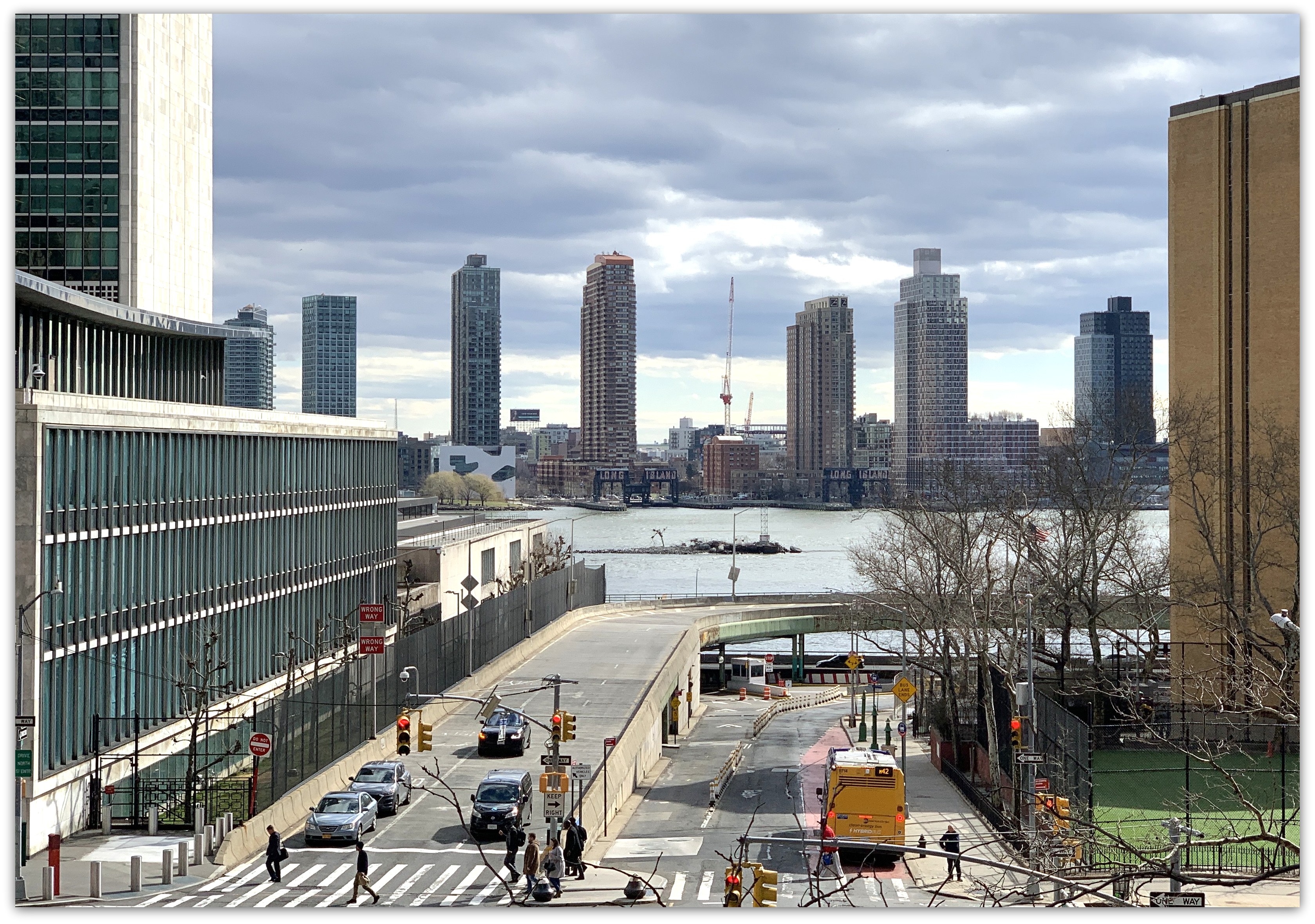
42nd Street comes to an abrupt end at the East River, then and now. 

1940

Above, the intersection of 42nd Street and 1st Avenue in 1940. The buildings all have something to do with the meatpacking industry. There is not much happening in the river, nor on the Long Island City side either.

2023

83 years later, the atmosphere is quite different. On the left there are buildings part of the United Nations, and on the right the air duct for the Queens-Midtown Tunnel. Across the river, once sleepy Long Island City is not so sleepy anymore. About the only thing surviving is the bed of rock in the river left over from the excavation for two trolley tunnels linking Manhattan to Queens in 1890. Today, the islet is owned by the state and is used as a sanctuary for migrating birds.


July 10, 2022

THEN AND NOW: The Entrance to No. 45

 Looking west from the entrance of No. 45, then and now.

The original photograph, made around 1928. 

In 2022, the most marked difference are the cars, both in numbers and size. The cobblestoned road was replaced by asphalt in 1952. As for the Lich Gate, it disappeared around this time too, as part of the neighborhood upgrades for the U.N. And finally, there have been remarkable advances in awning design.


September 9, 2020

THEN AND NOW

The lanterns bracketing the Prospect Tower plaque, then and now.

1988
Above, the plaque at the entryway of No. 45, bracketed by two stained glass lanterns, in 1988.  These appear to be the building's original lanterns, by then in a state of disrepair ‒ particularly the fixture at right, missing an entire glass panel. 

2020
The lanterns were removed at some point in the 1990s. Although nothing like the originals, the replacements have a acquired a vintage patina after 25+ years outdoors.


Speaking of fixtures on No. 45's facade, check out the story of its mysterious menu holder, here

June 28, 2020

THEN AND NOW: Graffiti Edition

Included in New York's Phase 2 recovery is graffiti removal, happy news indeed, and last month’s vandalism to No. 45 and the granite wall beneath it on 42nd Street is gone. A then-and-now comparison, below.
May 7, 2020, southeast corner of No. 45
June 23, 2020


May 7, 2020, 42nd Street wall beneath No.45
June 23, 2020


A shout-out to the boards and shareholders of No. 45 and The Manor for underwriting the cleanup, particularly Michael Gribin and Konrad Wos, who spearheaded the project. Graffiti removal was permitted starting June 22nd, and the blight erased on the 23rd because of their efforts. Well done!

June 17, 2020

THEN AND NOW

Looking west from 42nd and First, then and now. 

Circa 1935
Looking west down 42nd Street from First Avenue, the view is dominated by the mammoth 42nd street tunnel. Erected in 1880, it would stand until the late 1940s, when it was demolished and replaced by the Tudor City Bridge.


2020
A more streamlined approach to the traversing the street, the Tudor City Bridge is so minimal that it's barely visible, obscured by a stoplight, traffic signs and foliage.


March 29, 2020

Then and Now: First Avenue

First Avenue, looking south from 45th Street, then and now.

1946
Photo by Wurts Brothers, looking south down First Avenue from 45th Street, Tudor City at center right. At the time, the corridor was devoted to meatpacking, and officially named the Abattoir Center; locals called it Slaughterhouse Row

The smokestacks are part of the Consolidated Edison steam plant. 

2020
74 years later, the same view is much airier than expected. Razed in 1948, the Abattoir Center was replaced by the United Nations campus, at left. The steam plant was demolished in 2007, and has been a vacant lot ever since. 


March 11, 2020

Sign Appreciation Day

Frankly, every day is Sign Appreciation Day on this blog, and to celebrate it today, here's a visual record of the sign's recent renovation. All photographs by Lucas_D_in_NYC, Instagrammer extraordinaire.
Before renovation, April, 2019.

July, 2019. Shrouded in netting and scaffolds.

New letters being installed, January, 2020.

Tudor City noir, January, 2020.


February, 2020. Shiny and new.

See more of Lucas's spectacular photos of the colony here

⸺⸺⸺⸺⸺


Bonus photo from faithful contributor Garth Justice, showing the 'O' in progress.

January 28, 2020

AT LAST

The Tudor City sign, January 27, 2020.
Regular readers are well aware of this blog's obsession with the renovation of the Tudor City sign, so it's a thrill to report that the netting and scaffolding were removed Monday, and the sign can now be seen in all its refurbished glory.

In place since Tudor City opened in 1927, this historic sign ‒ said to be the only extant sign in Manhattan advertising an apartment complex ‒ has had many alterations over the years. Originally lit with incandescent bulbs, it was converted to neon in 1939, then completely rebuilt after toppling over during a storm in 1949. Around 1990, it went dark, and has been in a state of advanced decrepitude ever since. This latest renovation, eight months in the making, was begun in May, 2019.

A then-and-now comparison, below.
2012

2020
The renovation included refabricating the deteriorated steel inlays of the letters, which were painted metallic gold, mimicking an earlier color scheme. The framework was structurally sound, and repainted black. 


At present, there are no plans to illuminate it, though our dream is to see it softly floodlit at night, like the Silvercup Studios sign in Long Island City. But for now, it's great to see this neglected landmark back in the game and looking so snazzy.

A more detailed history of the sign here

Thank you to Anne Stoddard for the progress reports.