Showing posts with label Overview. Show all posts

August 16, 2020

What Makes Tudor City Historic?

Someone asked us the other day what exactly makes Tudor City historic. While we can think of thousands of reasons, it's probably best for the Landmarks Preservation Commission to spell it out. Herewith, a summary taken from the 1988 Tudor City Historic District Designation Report. The principle reasons for the community's designation are its:
Designation report cover
★ "Unprecedented size."

★ "Rapid construction."

★ "Revolutionary financial planning."

★ "Immediate and sustained popularity with New Yorkers."

★ Its parks, "the green core around which Tudor City revolves."

★ Its "extravagant" Tudor Revival architecture, which provides a "distinct sense of place." (Hotel Tudor's "art deco setbacks and raised brick patterns" are also cited.)

★ A design "sensitive to its physical context" that includes much "fine ornament and stained glass" that remains in its "original state."

★ Finally, this "pioneering venture in private urban renewal" brought about "the return of middle-class respectability to Midtown's East Side. . . Subsequent apartment building complexes incorporated lessons learned from Tudor City."

⸺⸺⸺⸺

Access the entire 81-page designation report here.

May 21, 2018

Building Spotlight: CHURCH OF THE COVENANT

The finale of our series profiling each building in the Tudor City Historic District. We conclude with one of the enclave's oldest structures, The Church of the Covenant, a Presbyterian house of worship opened in 1871.
The church in 1934, wedged between
 The Woodstock and Hotel Tudor.

Its architect, J. Cleaveland Cady, designs a red-brick Victorian Gothic structure, consisting of two buildings ‒ a chapel and a parish house ‒ sharing a common wall.  (Cady is then at the beginning of his career, but goes on to design such famed edifices as the American Museum of Natural History and the original Metropolitan Opera House).

The parish house is enlarged in 1927 in an Elizabethan style with half-timbered walls, meant to harmonize with the rising Tudor City around it.

There's one final, more radical renovation in 1950, when the road outside is lowered 17 feet, part of the regrading of 42nd Street. A staircase and new entrance are added.

Details: a wooden entrance door with decorative hinges, a copper steeple, a pitched dormer..
In 1950, when 42nd Street is lowered, a granite base is added, along with a flight of bluestone steps. The entrance is moved from north side to the west side of the building. Above, the alterations being made, and below, an early drawing of the finished product.


May 3, 2018

Tudor City Confidential's GREATEST HITS


Tomorrow marks the gala second anniversary of this blog, so today, here's a Top Ten List of our most-read posts over the last two years. The winner ‒ an overview of Tudor City ‒ was our very first post, and we've been trying to live up to it ever since. Click on the post name to read it.


Or make a pot of coffee, and scroll through the whole blog here.

December 6, 2017

Building Spotlight: PROSPECT HILL APARTMENTS

Continuing our survey of Tudor City Historic District buildings, here's a look at the Prospect Hill Apartments on E. 41st Street, which predate Tudor City by one year. Construction commences in July, 1925, when Fred French's planned community is still on the drawing board.

Entrance of 333 E. 41st St.
➼ Opens May, 1926. Six floors, with 36 apartments, a mix of studios, one- and two-bedroom units. 

➼ Designed and constructed by the Toensfeldt-Boughton architectural firm, the simple brick structure features a Tudor Revival entrance, adorned with a pointed arch, shields and pelicans, all rendered in limestone (at left). The rest of its facade is rather nondescript, most memorable for its numerous fire escapes.

➼ Some say that the Tudor ornament on this building inspires Fred French to design his community in the same style, but we don't buy it. Tudor-style architecture ‒ meant to suggest genteel 'country' living ‒ was very much in vogue in 1920s Manhattan. We believe that Tudor City's architect, H. Douglas Ives, made the call.

Below, the Prospect Hill Apartments in 1941, nestled between Essex House (left) and The Woodstock (top). The ice skating rink was a tennis court in warmer weather, and today is the site of No. 2, Tudor Gardens.
Building-wide typical floor plan.


⸺⸺⸺⸺⸺

Improbably enough, this modest structure is currently home to one of the biggest ticket listings in all of Tudor City ‒ ground-floor apartment 1E, on the market for a cool $900,000.

Apt. 1E's mod living room, with south-facing windows overlooking 41st Street.
The two-bedroom, two-fireplace pad is the largest unit in the building, and comes with an interesting backstory: originally built as the home of the building's developer, it has had only two owners since 1926.

UPDATE: Apt. 1E sold for its asking price in February, 2018.

July 5, 2017

Building Spotlight: TUDOR GARDENS, NO. 2

Concluding our survey of individual Tudor City buildings, here's the lowdown on Tudor Gardens, No. 2 Tudor City Place. 
Artist rendering from 1955 brochure
 8 Prospect Place, the hold-out
No. 2 is constructed decades after Tudor City's original phase of construction, since a hold-out building (at left) prevents development of the lot. It is finally acquired by the French Company in 1945, but it is not until January, 1956 that it is ready for occupancy.

➺ 15 floors, 333 apartments. Units range from studios to three-bedroom apartments.

➺ Faced with red brick, designed in a bland, no-nonsense style. Tudor City's only apartment tower without the Gothic embellishments found in the rest of the complex.

➺ Unlike the rest of the complex, it is a ground-lease co-op, set on land that the co-op rents but does not own. The current land lease is in place until February 1, 2150.

➺ The only Tudor City building with onsite parking in its own underground garage. Monthly rate is roughly $475 for outsiders, discounted for No. 2's residents.

1955 ad. Convenience to Midtown remains a top selling point,
along with free electricity and state-of-the-art General Electric kitchens.

Typical floor plan, 1955. The building is comprised of two towers connected by a central lobby.

June 19, 2017

The SOUTH PARK

Some time ago, we posted an overview of Tudor City's historic parks, and today we're zooming in on the South Park, opposite No. 25.

1940s postcard
The site originally houses a miniature golf course, a publicity windfall for the French Company that was originally conceived to distract from all the construction chaos around it.

But by mid-1930, most of the construction is complete and the miniature golf craze is starting to wane, so it's decided to reconfigure the site into a formal park. The Tom Thumb course moves across the street to the vacant lot that would later be used for tennis courts. 

Designed in the same formal English style as its northern cousin, the South Park has a similar gatehouse entrance and identical lamp posts. In addition, two octagonal gazebos, made from heavy timber, are set in its northeast and southeast corners. 
Like its northern sibling, the South Park is initially more lawn than park. This 1942 view looks east toward No. 25, showing the park's signature gazebo (top center) and gatehouse entrance (upper right).

A shady respite outfitted with English-style furniture and what appears to be the water hazard from the golf course still in place, opposite the bench.

A tender scene near the gatehouse. Locals referred to it as the 'Lich Gate,' 
after the British term for roofed gates in churchyards.


In 1952, the South Park is narrowed by 22 feet to widen Tudor City Place as part of the neighborhood upgrades for the arrival of the United Nations. The gatehouse and gazebos are removed, and the park is reconfigured as shown above, roughly the same layout it has today.

June 9, 2017

Tudor City DRINKING GUIDE

As a companion piece to our earlier post on dining recommendations near Tudor City, here is a guide to Where to Drink Near Tudor City. Once again, we've turned to our very close friend (a former Zagat nightlife editor) for suggestions. Here's what he had to say:

There are bars galore around Tudor City. If you don't care about ambiance and just want a drink, walk north up Second Avenue where there are more Irish pubs, sports bars and hook-up joints that you can possibly imagine. 

This is not a guide to these kind of places. We like some ambiance ‒ or at least a rooftop perch ‒ with our drinks, hence the following suggestions. All are within a 15-minute stroll from Tudor City.


Click on the bar name for more info.

S   W   A   N   K
The Campbell, set in the former office of Jazz Age financier John W. Campbell.
 Back after a hiatus, this posh hideaway in Grand Central formerly known as The Campbell Apartment could be the neighborhood's coolest, classiest bar. Now run by the Gerber Group, it's looking better ‒ if darker ‒ than ever.

Bergamo's
The latest arrival is this new cocktail lounge across the street from Grand Central, a slick boîte with vaulted ceilings and plenty of room to mix and mingle at the 63-foot-long bar. 

Ophelia
 Known for decades as the Top of the Tower, this revamped rooftop lounge near Beekman Place has been given the deluxe treatment, with craft cocktails, slinky waitresses, and knockout city views. Bring money.

Ambassador Grill  
 Landmarked bar and grill that's a time trip back to 1976, the year it opened. Bring someone you don't want to be seen with, as it's usually empty.

Sakagura
 Hidden underground sake bar with an encyclopedic sake list.

Raines Law Room at The William
 Fancy Prohibition-era cocktails served in a speakeasy-ish lair in The William Hotel. A buzzer at the entry and call buttons for the waiter on the tables enhance its back-in-time vibe.


On the more louche side of swank is The World Bar (in the Trump World Tower), a relic from the Sex and the City era.

R  O  O  F  T  O  P  S
Pod 39's rooftop bar, whose terra cotta arches date from 1918.
Pod 39 Rooftop Bar
 It began life in 1918 as the roof garden of The Allerton, a men's club residence, and is now the swinging rooftop adjunct of Al Pastor, the taqueria downstairs. Expect a scene at prime times, better in off hours for serenity seekers. Formerly known as the Salvation Taco rooftop.

Bookmarks
 Like Pod 39's roof, this sweet spot atop the Library Hotel has the same vintage vibes thanks to the liberal use of terra cotta, tile and brick. The 1920 structure was coincidentally enough built by Fred F. French, our founder, as an office building (and was the home of the French Company for several years).

Henry's
 The smallest rooftop in this group, it compensates with intimacy and conviviality.

Rare Bar and Grill
 One of the first rooftops of the aughts, killer views of the Empire State Building.

A   N   D   .   .   .
Detail of a mural in The Overlook, created by members of the National Cartoonist Society 
in exchange for free food and drink.
 Standard-issue sports bar that draws Bears and Islanders fans. Notable for its back-room murals, created in 2005 by famous cartoonists, including Jules Feiffer, Mort Drucker, Mell Lazarus and Al Jaffee.

Hofbräu Bierhaus
 Brawny German beer hall with picnic table seating, live bands and dancing on the tables. Easy-to-miss entrance, then one flight up. Outdoor terrace overlooking scenic Second Avenue.

⸺⸺⸺⸺⸺⸺⸺⸺⸺⸺

See a MAP of these places here.

Click here for the ⭐Tudor City DINING GUIDE⭐


June 5, 2017

Building Spotlight: HOTEL TUDOR


Continuing our survey of individual Tudor City buildings, here's the lowdown on the Hotel Tudor, known within the French Company as the Twelfth Unit. It's the only building in the complex not designed for permanent residence, instead meant to be a transient hotel. It remains so today. 

➺ Opens October 1, 1930. Faced with red brick, rendered in a vaguely art deco style. The only structure without Tudor embellishments in the French Company's initial building effort. 


➺ Thru-block building has two towers connected on the lobby level, with entrances on both 41st and 42nd Sts. 


➺ 17 stories on 42nd St. side, 20 stories on 41st St. side. 300 rooms and suites, including several suites with private roof terraces. Over the years, the hotel variously houses a restaurant, cocktail bar and beauty shop.
Guest room, 1936
➺ The widening of 42nd Street for the approach to the U.N. in 1950 lowers the hotel entrance five feet, at a cost of $101,000. The city picks up the tab.

1950s postcard, 42nd Street entrance.
➺ In 1963, the French Company sells the hotel to an investment group, and since then, it changes ownership (and management) many times. Today, it's the Westgate New York Grand Central Hotel. 

➺ Like Prospect Tower, the hotel is topped by a landmarked neon sign that's now unlit. Below, a colorized version of Tudor City's neon corridor, when both signs were shining, adapted from a 1942 photo.


May 12, 2017

THE SIGN, Part Three

The third installment in our four-part series on the Tudor City Sign.

The sign in 2015. Tubeless, forlorn and forgotten.
In 1988, the sign is landmarked as part of the Tudor City Historic District. Although it's designated as part of a landmark edifice, it does have historic significance of its own. Electric roof signs advertising apartment houses are rare in NYC (much more common in LA), and this one is said to be the only surviving example in Manhattan.

It goes dark around 1990. One version has it that the sign is extinguished because its electric current is interfering with the UN's communications equipment. More likely is that it simply conks out, and the newly co-oped No. 45 doesn't want the expense of repairing it. It slowly falls into disrepair.


In 1995, No. 45 petitions the Landmarks Preservation Commission to have it removed, arguing that it's "in bad shape, made out of angle iron, and dangerously rusted out." Architecture historian Christopher Gray drolly notes that "over at Tudor City, it's not freedom of expression they're fighting for ‒ it's freedom from expression." 
After 15 minutes of deliberation, the commission rejects the application, calling the sign "a piece of real estate history."  

Thankfully, the saga of the sign has a happy ending. Read it in Part 4, here


Below, close-ups of the sign made in 2013.


May 10, 2017

THE SIGN, Part Two

Continuing the tale of the Tudor City Sign, today's installment picks up the story in 1942.
The 42nd St. corridor showing both the Tudor City and Hotel Tudor signs lighted.
Bottom center, the lights over the tracks of the 2nd Avenue El.
Shortly after this photo was made in 1942, wartime jitters lead to dim-outs in New York City. Less stringent than blackouts, dim-outs do mandate extinguishing all electric signs, and so both signs go dark. This does not go unnoticed. Charles Driscoll, in his nationally syndicated column New York Day by Day, writes

One of the signs outside Times Square that is really conspicuous by its absence in the dim-out is the one atop a tall building at the east terminus of 42nd St.
"Tudor City" was all it said.
But it said that so loudly that nobody could look east along the main east-west street without seeing it. . .
⸺⸺⸺⸺⸺⸺⸺⸺

The war and the dim-outs end. Then, one stormy day in September, 1949, the sign topples over. 

"Crashes down" actually, according to the monthly magazine Tudor City Viewwhich is the sole source for this news:
The high winds in September which sent the old Tudor City sign crashing down from the roof of Prospect Tower wasn't entirely an ill wind. For although this sign had been an eye-catching attraction to millions along 42nd Street, it was, nevertheless, outmoded. It has now been replaced by a new, giant-sized sign which embodies the most recent developments in sign lighting.
The story maddeningly omits a key fact, exactly where it came crashing down, but it seems safe to assume it was the rooftop and not the street. It is quickly replaced.

The original sign. . . . . . . . . . . . . . . . and its replacement.

Manufactured by the Broadway Maintenance Corp. of Long Island City, the new, "giant-sized" version measures about 30 by 50 feet with letters roughly 12 feet high. The color has changed from gold to red, and the sign has "more brilliant beams" because of "zeno florescent tubing, a modern substitute for neon." 

This 1949 sign remains in place to this day.

Continue to Part 3 here.


May 8, 2017

THE SIGN, Part One

All posts this week will be devoted to our favorite subject, the Tudor City Sign. Following, the complete, unexpurgated saga of the rise and fall ‒ and rise and fall again ‒ of this storied structure.
The sign, 2013.

In 1937.
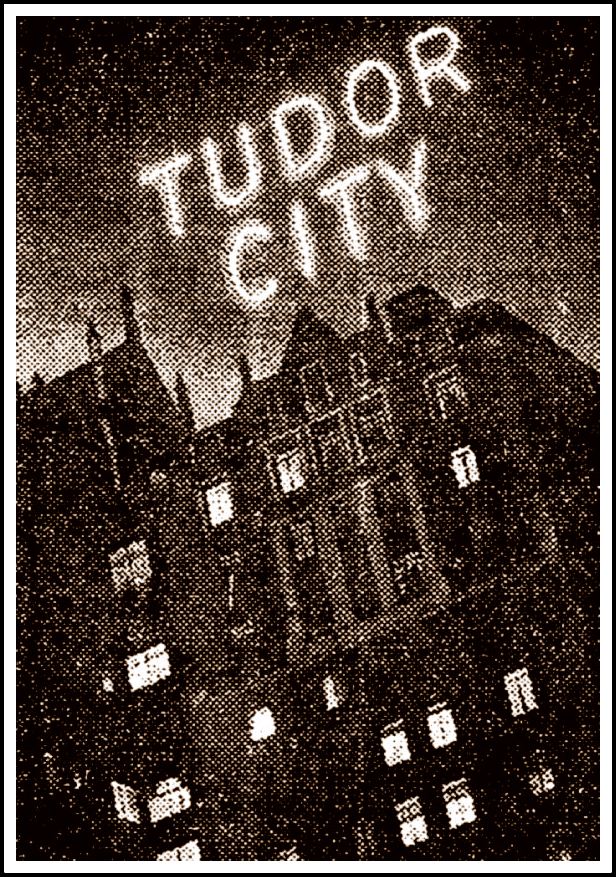
The Tudor City sign first lights up in late 1927, concurrent with the opening of its home base, Prospect Tower, No. 45. It never appears on the original renderings that the French Company prepares for Tudor City, suggesting that it's an impromptu, last-minute addition ‒ and a temporary thing to be removed once all of the apartments are rented.

But Fred French is impressed by its striking presence on 42nd Street. Illuminated by white incandescent bulbs, it can be seen clearly from Grand Central Station, and the message to its commuter audience is just as clear: If you lived here, you'd be home by now. 


Fred French orders a twin sign installed across the street on the rising No. 25.
Above, artist rendering of both signs in 1928.
No. 25's sign has a short lifespan, however. After the 32-story Woodstock opens in 1929, the sign is obscured from view (below) and removed around 1931.
Photo taken from the Chrysler Building, 1929. Bottom right corner, the Daily News Building under construction.
In 1939, the remaining sign is retrofitted by the Claude Neon Lights Company with neon tubes in "fluorescent old gold," the same classy shade used for the letters on the RCA Building in Rockefeller Center. 

Reinvigorated and looking good, the sign shines on for another decade, even as impending disaster looms.


Continue reading Part Two here.


April 14, 2017

Building Spotlight: ESSEX HOUSE

Continuing our survey of individual Tudor City buildings, here's the lowdown on Essex House, known within the French Company as the Tenth Unit.
Carved into stone scrolls over the entrance are the words "Designed, Constructed, Financed and Managed by the Fred F. French Companies, Anno Domini One Thousand and Nine Hundred and Twenty Nine."

➺ Opened October 6, 1929. Faced with red brick, trimmed with limestone and terra cotta. 

➺ 10 stories. 94 apartments, including four penthouses with roof terraces. Offers everything from studios to three-bedroom units, although the majority are larger, "family-size" units. All are designed as housekeeping apartments, with larger kitchens than in the tower buildings.

➺ An entrance porch with flagstone paving connects two wings of the building and is flanked by three original iron standing lamps. Geese, Fleur-de-lis, Tudor roses, and the Shield of New York are incorporated into the design, along with winged monsters (at left).

Essex House pictured in a 1930 brochure.
1930 floor plan for a two-bedroom, three-bath unit, complete with maid's room.

Detail of 1929 ad. 
Marketing to families was a new concept for Tudor City.

March 20, 2017

Building Spotlight: WINDSOR TOWER, NO. 5

Continuing our survey of individual Tudor City buildings, here's the lowdown on Windsor Tower, No. 5, known within the French Company as the Ninth Unit.
Windsor Tower's western and eastern facades, as rendered on SimCity, a city-building computer game.

Detail of 1929 ad
➺ Opened January 1, 1930 as an Apartment Hotel (efficiency apartments offering hotel amenities like maid and laundry services, as well as a central switchboard). Faced with red brick, trimmed with limestone and terra cotta. 

➺ 22 stories, plus 4 sub-floors. 788 apartments, the most of any Tudor City building, primarily studios and one bedrooms. The only building on Tudor City Place to offer river views, because the slaughterhouse district ended one block north.

➺ Considered the grandest building in the complex because of its 10 showplace penthouses, with dizzying city views and drop-dead double-height ceilings.
Studio floor plan, 1930. Dotted lines represent Murphy beds.


No. 5 offered the most services of any Tudor City building, as shown above, circa 1941. The Grey Room was a community space used for dances, lectures, art exhibits and the like.

No. 5 also houses a block-long SHOPPING ARCADE at its eastern base. Now unoccupied, it variously housed a radio shop, a Studebaker showroom and the clubhouse of the Tudor City Camera Club over the years. We think its fortunes are looking up with the current (and inevitable future) development along First Avenue.

February 21, 2017

Tudor City DINING GUIDE

A friend of this blog edited the Zagat restaurant guide for many years, and has agreed to spill the beans on where to eat near Tudor City ‒ 'near' meaning a ten-minute walk, or less. Here's what he had to say:

Hello, fine readers of this exceptional blog! The simple answer to your question is Grand Central Station, which rather improbably has morphed into a real dining district over the last few years, with many varied (and inexpensive) options. 

Of course, there are many other alternatives in the area. Following are my recommendations, divided into two sections: Grand Central and Beyond Grand Central. Click on the restaurant name for more info.


G R A N D   C E N T R A L

AGERN

  Hard-to-find place within Grand Central [enter at 42nd & Vanderbilt Ave, walk down ramp, turn right]. Cutting-edge Nordic menu stressing foraged wild ingredients. One Michelin star, three New York Times stars. Serves lunch Monday‒Friday, dinner MondaySaturday, closed Sunday.
OYSTER BAR
  Landmark seafood specialist, in business since 1913. Specialty of the house the oyster pan roast, an olde NY throwback dish if there ever was one. Instagram-ready 'Whispering Galley' just outside the entrance.
SHAKE SHACK  
  Elevated fast food (burgers, wieners, shakes) from restaurateur-entrepreneur Danny Meyer. Opens at 7 AM!
LA FONDA DEL SOL
  Re-creation of a famed, same-named 1960s restaurant, serving a Spanish menu, heavy on the tapas. Mood and decor very Mad Men.

URBANSPACE VANDERBILT   Hit food hall with an array of hip vendors. Brooklyn aesthetic (bare girders, concrete floors). Counter service, limited picnic-table seating and prime-time mobs make it best for takeout, or at off hours. Closes 9 PM weeknights, 5 PM weekends.
Notable vendors:
ROBERTA'S 
  Famed pizza purveyor, a spin-off of the highly regarded Bushwick original. 
RED HOOK LOBSTER POUND 
  Lobster roll the way to roll. Cloned from the Red Hook original.

Vendors rotate in and out of the line up. See here for current list.


B E Y O N D   G R A N D   C E N T R A L
. . . but still within 10 minutes from Tudor City.

AL PASTOR
  Formerly Salvation Taco, this taqueria in the Pod 39 Hotel is now run by Alex Stupak, the chef behind the Empellon empire. Look for fancy tacos and redesigned digs with a publike vibe.
AVRA  
  Classy Greek seafood, primo outdoor seats. Grown-up crowd willing to spend money.
CAPITAL GRILLE
  Steakhouse, but more about its spectacular Trylon Towers glass ceilings.
CRAVE FISHBAR  
  Seafood specialist with a young following. Mellow setting and vibrations.
LUKE'S LOBSTER ROLL  
  Consistently rated one of city's best lobster rolls. Picnic-table seating and ambiance.
OSTERIA LAGUNA
  Literally the closest good option to Tudor City, a 5-minute walk away. Pleasant Italian menu, convivial crowd, glamorous lighting.
PERSHING SQUARE  
  All about the setting, a long chamber beneath the Park Avenue Viaduct. Best for breakfast.
SARGE'S DELI
  Circa-1964 deli specializing in extravagantly stuffed, heart-attack-on-a-plate sandwiches. Open 24/7.
SHAKE SHACK 
  Elevated fast food (burgers, wieners, shakes) from restaurateur-entrepreneur Danny Meyer. Sometimes less crowded than the nearby Grand Central outlet.
THE SMITH
  Turtle Bay link of the rocking mini-chain. American bistro eats. Crushingly loud and always busy, especially for brunch.
SOCARRAT PAELLA BAR
  Paella practitioner spun off from acclaimed Chelsea original. Casual mood, rustic room, toothsome Spanish chow.
SPARKS
  Storied steakhouse in place since 1977. Mood very old-school, tabs very expense account.
SUSHI YASUDA
  Michelin-starred sushi bar. Widely considered to serve some of the best sushi in town, even though original chef Yasuda is long gone.


⸺⸺⸺⸺⸺

See a MAP of these places here.


Click here for the ⭐Tudor City DRINKING GUIDE⭐